This week’s 52 Ancestors prompt is Changing Names which, to be honest, caught me off guard for half a minute. Once I thought about it a little more, I thought that historically women are the ones who most commonly change their names when they get married. Doing a little research into the background of this practice I uncovered something called the doctrine of coverture —which dates back to 9th century England— and literally means ‘covered by’. Under the concept of coverture, women had no independent legal identity apart from their spouse. But coverture laws also prevented women from entering into contracts, engaging in litigation, participating in business, or exercising ownership over real estate or personal property.
A Clear Choice
Thinking about all elements of this practice and thinking about all of my female ancestors, the choice was very clear for me. I had to write about my 6th great-grandmother Elizabeth Osborn (1716-1798) —more commonly known as Elizabeth Osborn (Myrick/Paine/Doane)— a lady who changed her name three times, once with each successive marriage. I have wanted to write about her for a long time —she being one of my favourite ancestors— and I couldn’t think of a better coincidence than to begin writing her story on International Women’s Day (March 8, 2024) and posting it during Women’s History Month in the USA. For the 1700s, she was a women ahead of her times, in so many ways.
I was recently asked by my sister-in-law, how I know so many details about our ancestors. I told her that on my mother’s New England side I have been lucky to have so much written material available about many of the significant family members through history. When I say this though, I am mostly referring to the men in the tree. The females however, for the most part, have had very little documented about their lives. Fortunately for me, such is not the case when it comes to Elizabeth Osborn. Her life story transcended time and was passed down orally through the generations.
A Bouquet of Sources
From the 1800s, her story has been captured in written format. Elizabeth’s great-grandson Arnold M. Doane (1833-1911) —a highly educated music professor and notable Nova Scotia historian— captured many details about his ‘Old Grandmother Doane’ in his unpublished notebooks that are known today as ‘Doane’s Notes’. And, although the publication date is unknown, Edwin Crowell’s epic book “A History of Barrington Township and Vicinity“—which is based on Doane’s notebooks— covers Elizabeth’s life extensively —along with many other planter families of that area. Elizabeth was also written about in a 1912 book produced for the Doane Family Reunion in Barrington, Nova Scotia. In 1975, Phyllis R. Blakeley —a Nova Scotia Archivist at the Provincial Archives— wrote a 9 page article about Elizabeth entitled “And Having a Love for People” —words Elizabeth used in her petition covered later in this blog post. Eventually Phyllis would write a shortened version of her story for the online Dictionary of Canadian Biography. Bringing Elizabeth’s story into this century and a new millenia, in July 2000, Sylvia Doane-Lavigne (1923-2019) —a 4th great-granddaughter of Elizabeth’s— wrote and performed in a one-act, one-character play based on Elizabeth’s life. Her life has also been documented in unpublished diaries in Nova Scotia archives —much of them summarized in the detailed Thomas Brenton (T.B.) Smith Collection.
In the 1912 publication mentioned above, Herbert L. Doane —a 3rd great-grandson— wrote about Elizabeth, “she was a young lady possessing superior ability, beauty and character, the A B C of feminine charm, and doubtless she had many admirers”. “Elizabeth was a woman of considerable education, of more than ordinary personal attractions and natural ability.” Her story is one of Love, Loss, Resiliency and Caring. She was a survivor who many times looked tragedy in the eye and never let it deter her from moving forward and caring for the people around her. I hope you enjoy her story as much as I enjoyed researching and writing it.
A Sandwich A Vineyard and Some Good Stock
Elizabeth was baptized, likely in Sandwich, Massachusetts in 1715, a daughter to Rev. Samuel Osborn (1685-1774) —an educated man from Northern Ireland and the constantly persecuted pastor of the South Church of Eastham, Massachusetts— and Jedidah Smith (1689-1743). Through her mother, Elizabeth was the great-great-granddaughter of Governor Thomas Mayhew (1593-1682) —at one time the Grantee and Governor of Nantucket, Martha’s Vineyard and the adjacent islands.
Unlike other female ancestors I have written about in past posts —especially Catherine O’Donoghue in last week’s blog— we know a surprising amount about Elizabeth’s younger life thanks to the resources mentioned above.
A Thimble full of Foreshadowing!
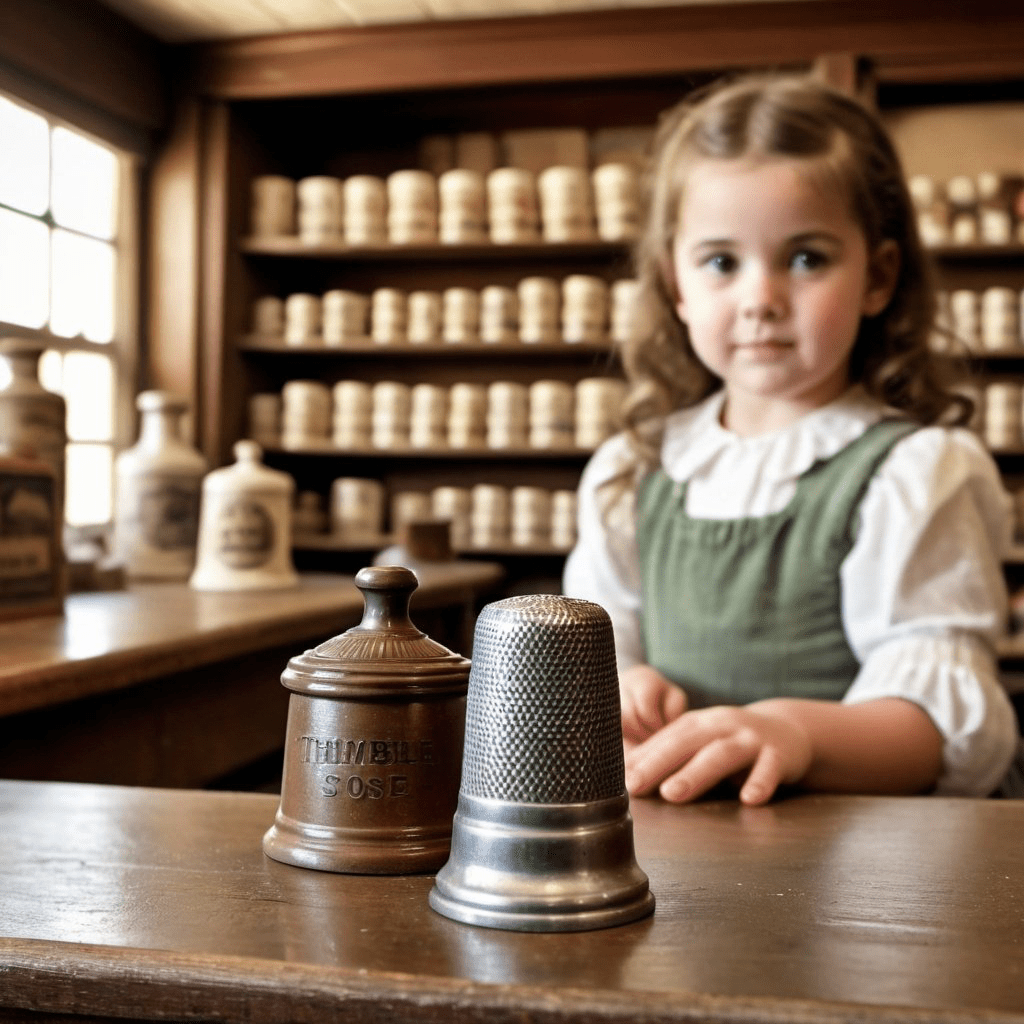
When Elizabeth was a very young child, a funny family lore story —yet foreshadowing her life— is that she stole a thimble —innocently or otherwise— from the store owned by a Mr. William Paine. Apparently a lady had accidentally left it on the counter before leaving the store and young Elizabeth decided to take it home. When her father heard what happened, he forced her to return it to the shop and apologize to the owner. Her confession and apology was so ingenious and it pleased Mr. Paine so much that he said she should be his wife some day. Remember that story for later!
School Books Tutors & Harvard Kin
We know that Elizabeth was highly educated as a young girl growing up in Eastham, Massachusetts. She went to regular school but was also tutored by her highly educated father —who started and ended his career as a school teacher. Her brother John attended Harvard and would go on to be a successful physician, so we know education was prioritized growing up.
Mayflowers & Young Love Still ‘Doane’t’ Match
As a young girl, Elizabeth grew up with a boy named Edmund Doane. Edmund was the gg-grandson of Gov. Thomas Prence (1601-1673) —a former governor of Plymouth Colony— and Patience Brewster (1600-1634) —daughter of Mayflower passenger William Brewster. In fact, Edmund’s father also descended from one of the founding families of Eastham. The childhood friendship grew into love but —in spite of his lineage— it did not come with the approval of her father. Given that Edmund was two to three years Elizabeth’s junior, the age probably played a factor in her choosing someone else to marry.
1st Name Change – Swept up by a Sailor
Still a teenager, Elizabeth first married a dashing sailor named William Myrick/Merrick (1706-1742) on 23 January 1733, who was 10 years her senior. William is a 3rd cousin of mine several times removed, as well as being a Stephen Hopkins Mayflower Descendant . After less than 10 years together, Captain William Myrick died at sea in 1742 —a common fate for seamen in that timeframe— leaving Elizabeth a widow with 3 young children; William (8), Gideon (7) and Elizabeth, a.k.a. Betty —who was born 3 months after her father’s death. This scenario would have left Elizabeth in a desperate situation if not for the fact that she was made administrator of her husband’s estate which provided funding to maintain the house and family —an unusual scenario for those times. The year following her husband’s death, Elizabeth lost her mother. Another devastating blow to the family.
2nd Name Change – The ‘Paine’ of War
Eventually, Elizabeth was courted again by her childhood sweetheart —Edmund now 24 and still single. Although I am sure she had feelings for him, she decided to become the second wife of widower William Paine Esq. (1695-1746) —a Mayflower descendant of both Stephen Hopkins and William Brewster and a second cousin of mine several times removed who shares many common ancestors— a wealthy merchant 20 years her senior who was also a magistrate, and a politician. They were married by Reverend Joseph Crocker on 14 January 1745. Unfortunately, along with being a gentleman, William was also an officer in the Massachusetts colonial forces.
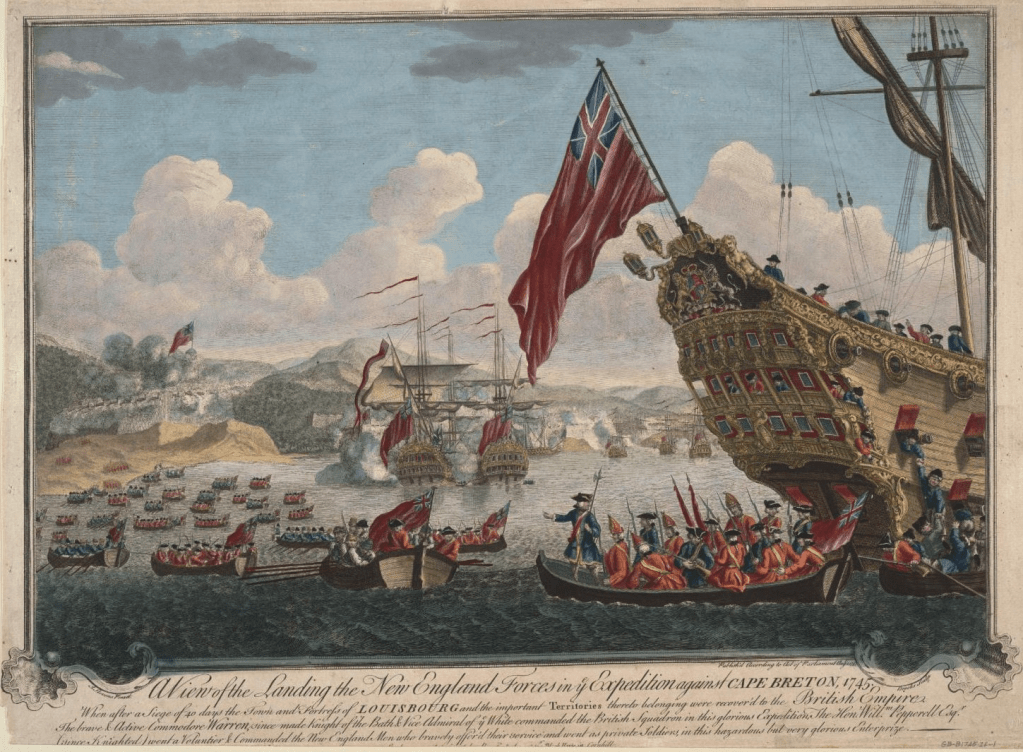
William was part of the New England men who joined with British forces in the Siege at Louisburg —today’s Cape Breton, Nova Scotia— in 1745. He died at Louisburg in August or September 1746. In the meantime, Elizabeth gave birth to another son, William Osborn Paine in 1746, named after his father who he would never have a chance to meet. After an inventory of William’s estate was taken, it was declared insolvent. Maybe she should have kept the thimble after all! 😉 Back to that wealthy part, lesson here is appearances aren’t everything.
3rd Name Change – Destiny is All!
It took 3 years —and maybe Edmund’s courting was a little lukewarm after being turned down twice— but Elizabeth —at 33 years old and with 4 children of her own— finally realized that maybe God meant them to be together all along and she wed her childhood sweetheart, Edmund Doane, on 10 Nov 1749. Over the next ten years, they had seven children together; Israel b. 1750, Prence b. 1751, Samuel b. 1752, Jedidah b. 1754, Ruth b. 1756, Abigail b. 1758, and Edmund b 1759.
Birth Rights & New Sights
In New England —after many generations of carving up land among sons— being the youngest male in a family —as Edmund Doane was— meant there wasn’t much land left to sustain a family. In 1758 and 1759 General Charles Lawrence —the Governor of Nova Scotia— offered New Englanders significant amounts of land in Nova Scotia if they migrated with their families. The offer had an ulterior motive of colonizing land recently vacated as a result of the French expulsion from that part of the province by the British forces. In Autumn of 1761, Elizabeth and her husband Edmund Doane —along with Elizabeth’s father Samuel Osborn and many other New Englanders wanting a better life for themselves— accepted the offer of land and became ‘planters’ in Barrington, Nova Scotia. Although the distance between Eastham, Massachusetts and Barrington, Nova Scotia by boat was less than 300 nautical miles, the waters in that area could be very treacherous at that time of year and the towns were figuratively worlds apart.
Gales Wreak Havoc
Edwin Crowell wrote of the Doanes’ journey “he had his two story house taken down, the posts cut shorter to make it one story, and the roof made something like our present Mansard roofs. He hired a vessel, got his house frame and material on board with a quantity of grain and other vegetable products, some cows and heifers, a mare, some pigs, his furniture and effects and was about ready to leave when a gale sprung up, the vessel went on shore, and vessel and cargo were scattered along the beach. He saved what he could, got another vessel, embarked the remainder of his effects, and with his family soon left for Nova Scotia.” As if this wasn’t bad enough, another autumn storm drove their ship past Barrington to Liverpool, Nova Scotia. Given that winter was quickly approaching, Edmund decided to stay and winter there. As they were attempting to row their boat ashore however, a restless sow upset the boat and many of their supplies were dumped into the depths of the ocean and lost. They had to spend the winter in a rough storehouse that suffered from cracks and leaks. How they survived, one can’t even fathom, given how extreme the winter was.
Angel of Mercy
Nova Scotia diarist Francis F. Tupper writes of that winter of 1761-72 when the Doanes were in Liverpool. Talking of Elizabeth Osborne Doane, he stated that it must have been this pitiful environment that “started her on her errands of Mercy about the town that winter of Liverpool’s famine, when people sometimes were living on rabbits, and sickness was so prevalent. Who can tell what good she may have done. It was a great wonder that every child born that winter at Liverpool did not die and the mothers with them. But God’s mercy and the ministrations of Betty Doane pulled most of them through safely. Only one mother died.” He went on to name numerous women and children who survived only because of her care. Some even named their children after her.
Home Alone and an Old Mare
In the spring of 1762 the Doanes sailed for Barrington with the only remaining livestock, the old mare, the others having died from starvation and exposure over the winter. From Doane’s Notes we learn that their eldest son Israel —my 5th great-grandfather— was so worried (rightfully so) about the overloaded boat that his parents had chartered for their journey, that he jumped aboard another boat to Barrington. The family thought he had stayed behind (Home Alone style I guess!) and they were very surprised to find him in Barrington when they arrived after their winter in Liverpool. Apparently his ride was successful in reaching Barrington and he stayed with that family through the winter. (I don’t make up the stories folks…I just relay them.)
Praying for Family through a ‘Paine’ of Glass
Another interesting, and sad, story that came out of this family departure, was that of young William Osborn Paine —Elizabeth’s son with William Paine. He was under the impression that he would be joining the family on their exciting journey to Nova Scotia, even though he was currently being boarded out to Reverend Crocker for his education. Sadly, his mother told him that there would be insufficient education opportunities where they were going and that he would be better off staying behind. Years later, in a letter to Samuel Osborn Doane —one of his 1/2 siblings— he described the anguish he felt as he watched his mother and step-father —along with his Doane brothers and sisters— pass by the window of Rev. Crocker’s house as they were in the middle of prayers. He wanted to run out and say goodbye but it would have been inappropriate so he just watched in sadness as they departed. He wrote “I have never yet forgotten my sensations when I saw the family passing the window (where I stood attending family prayers) on their way to embark at the landing by Mr. Nathaniel Mayo’s. Providence overruled my wishes —undoubtedly for the best— and I am certain that my mother used her best discretion in leaving me with that good clergyman whose memory I revere.”
A Shop A Tavern and A Homer!
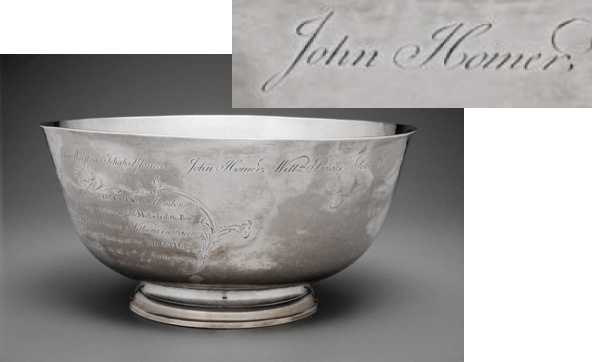
Upon arrival in Barrington, the Doane’s settled down, built the first frame house in that area of Nova Scotia and opened a ‘general store’ —selling goods required of a growing town— and a tavern —likely to drown the sorrows of those who had made the journey from New England. Edmund obtained his supplies from Elizabeth’s brother-in-law, John Homer, who was married to her sister Abigail. John was a Boston merchant and shipowner —and more famously a member of Boston’s ‘Sons of Liberty’ —and who has his name forever etched into ‘The Sons of Liberty Bowl’. (Note: The Sons of Liberty Bowl, the Declaration of Independence, and the Constitution have been called the nation’s three most cherished historical treasures.) He would eventually move to Barrington in 1775. There is insufficient evidence to determine whether he was trying to protect his family from the Revolutionary War (1775-1783) or through the years he had changed causes. Regardless, his family integrated and became well respected as leaders in their adopted homeland.
Babies Herbs and Heirlooms!
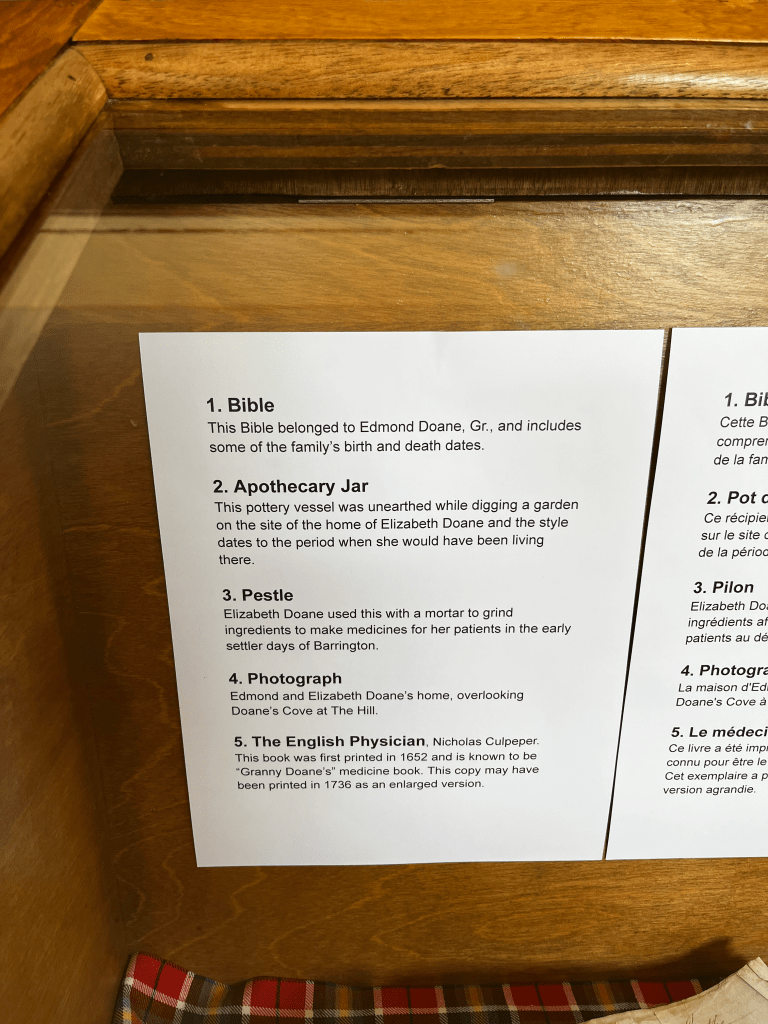
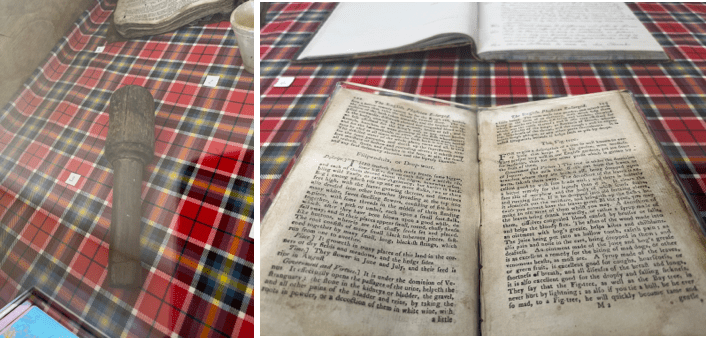
Along with caring for her large family, Elizabeth continued to perform midwifery duties and administer all other sorts of required medical assistance to the inhabitants of Barrington and the surrounding area. Although there was no obvious formal training in these skills, her brother had been an educated doctor, —although he had passed before they left for Nova Scotia— her nephew John was one of the founders of the State Medical Society in Connecticut, and her son William Paine had started medical studies as well. So, it is possible that she had communication with these resources over the years. Of Elizabeth, the ‘Doane Family Book’ states that “having a good knowledge of medicine, and being skilled in the use of roots and herbs, she was the only nurse and doctor to all the sick of the township. Her services were much sought after and appreciated.” Elizabeth had also picked up a knowledge of herbs and other natural medications from books she had as resources. In fact, her pestle and herbs book —’The English Physician’ by Nicholas Culpeper— has survived the ravages of time and are now both on display at the Barrington Museum Complex’s ‘Old Meeting House’ in Barrington, Nova Scotia. I visited the museum and meeting house this past September and was in awe to see these family heirlooms displayed along with Edmund Doane’s family bible.
Selling Out & Readying the Sail
The inhabitants of Barrington suffered many hardships in the early years and had little cash to pay for things. Life as a shopkeeper in Barrington, as a result, had been very tough for Edmund, and in 1766 he sold the property and general store to John Homer —who was still residing in Boston— for £132.6.5 3/4. Apparently Edmund and the family never planned to stay in Nova Scotia forever and over the next few years things weren’t getting any better. In 1770, having disposed of all property in the town —and after Elizabeth’s father had already returned to New England— it appeared that the plan was for Edmund and Elizabeth to head back home as well. Her father Samuel Osborn said of Barrington, “it was the only place he was ever in, where if the Lord rained porridge —there wouldn’t be something to put it in”.
Life Lines Happy Wives & Saving Graces
Sometimes, well made plans take a turn. After word spread of the Doanes’ intentions to return to New England, many women in the town —for whom Elizabeth had been a literal ‘life line’ for so many years— convinced her to petition the town for land to be used to build a suitably located house. Her petition dated 13th May 1770 reads in part: “Elizabeth Done being destitute of accommodation of land to set a house upon but am nevertheless free and willing to exert my faculties and skil in [physic and surgery and midwifery] and having a Love for the People…request the favour of…a small tract of land…containing one & half acres more or less…”. Thirty-eight proprietors of the township signed the petition in support of Elizabeth’s request —all of them men. I am sure the wives had a say in how much support she received for her petition. The land was granted to Elizabeth, in a move that would have been rare —but necessary— for that timeframe.
Deliveries of a Different Kind!
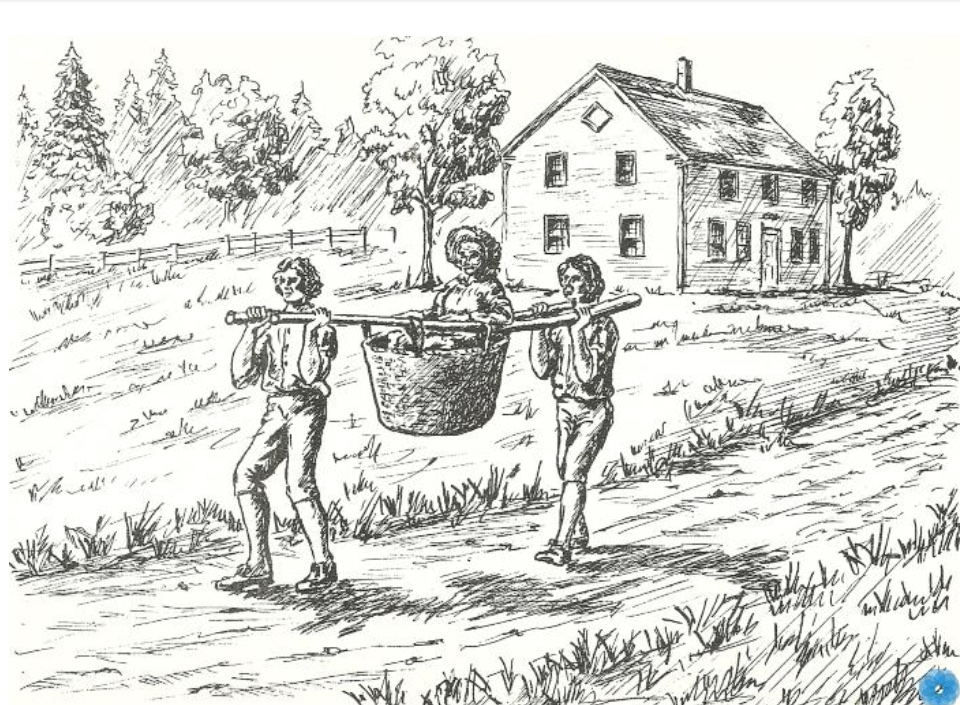
By 1770, Elizabeth was 55 —and having lived a full life that would likely have deserved her time for rest— she decided to continue to serve her community for many more years. Although she was very used to delivering babies in the district, when Elizabeth was too old to make house calls using her own mobility —in poor weather and at distant locations— she herself was delivered to the home —carried in a suspended basket by two men supported by poles on each side— as depicted in the modern illustration below. Now, that’s a version of Uber way before its time!
Faded Memories Etched in Stone & Home Sweet Home
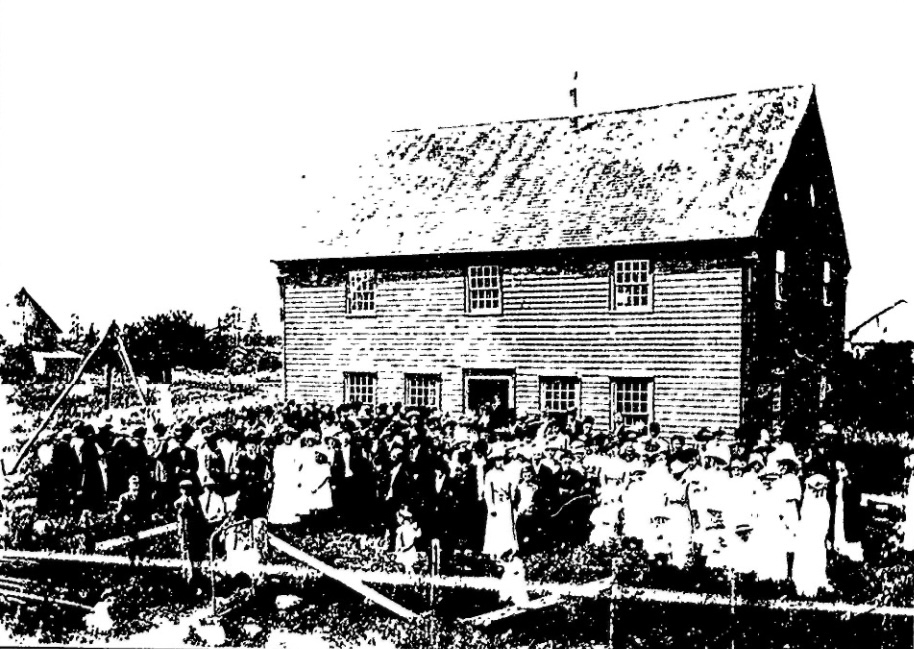
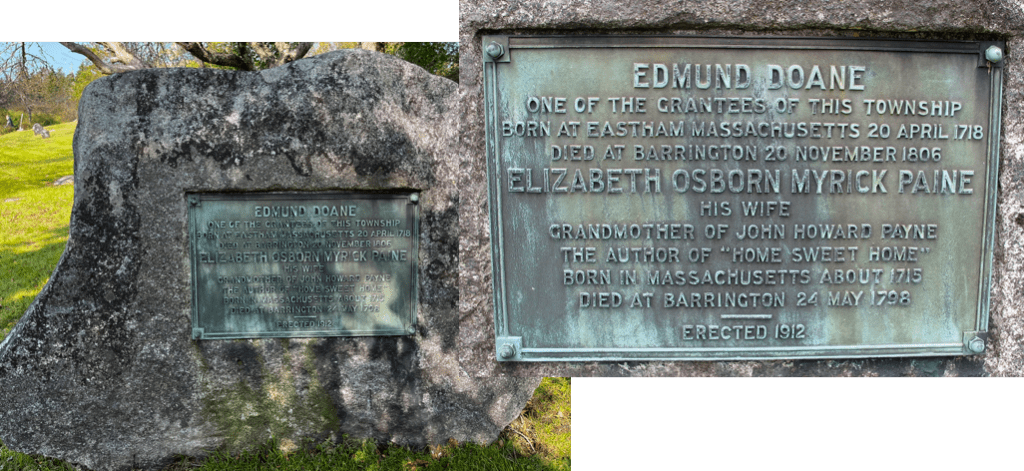
As mentioned above, in 1912 a reunion of the Doane Family was held in Barrington. By all accounts it was a significant and well attended event for the family (see photo below). As part of the festivities, a memorial plaque —embedded in a massive stone— was placed just outside the ‘Old Meeting House’ in Barrington to commemorate the lives —and mark the general burial area— of Edmund Doane and his wife Elizabeth Osborn Myrick Paine Doane. Sadly, after all that my 6th g-grandmother had done for the town, her family memorialized her as the “Grandmother of John Howard Payne, The Author of “Home Sweet Home””. I realize that this was a significant achievement for her grandson —and certainly made him well known around the world— but she devoted her life to a community which surely should have meant more than a grandson’s achievement. Such were the times I guess. (Note: John Howard Payne (he changed the spelling of his last name) is my 1st cousin 6 times removed. I have included a video of Perry Como singing his famous song below.)
I have often thought, of all the ancestors I have, I’d love to have a meal with her and spend the evening hearing about her life. I am so grateful that others have kept her story alive. I am hopeful, that 100 years from know someone may come across this version and smile!
Postscript: Midwifery Humanity & Compassion Genes in the DNA
I’d like to think that some of Elizabeth’s DNA —even though it’s 5 generations to my mother— is somehow over-represented in my Mom. My mother had a 39 year nursing career, of which 33 were taken up working with babies and young children. She spent 17 years bringing babies into the world in the delivery room between St. Clare’s and Grace hospitals in St. John’s, Newfoundland, 5 years in the children’s Operating Room at the Janeway hospital —a children’s hospital in St. John’s— and another year in paediatrics at St. Clare’s hospital. That doesn’t add to 33 yet, right? It would be the last 10 years of my mother’s career that would have some of the greatest impact on babies and their families in St. John’s. She worked in the Maternal Fetal Assessment Unit at the Grace Hospital where she did ultrasounds on high risk pregnant mothers. Quite frequently she would remain at her station for quite some time after her shift was supposed to be over. Many times I was waiting outside in the car to pick her up —and those were days well before cell phones and texting. As frustrating as it was for a young teenager at that time —upon eventually arriving at the car— she would remind me that she was dealing with an urgent situation with a mother who had lost a child or they found irregularities or some other critical issue that was definitely way more important in life’s metrics than my time sitting impatiently in the car.
From the time my mother was in Nursing school she was winning awards for her quality of nursing care. But it was in 2000 —very near the sunset of her long career and after years dealing with the challenging circumstances that came with the fetal assessment job— that she was given a ‘Bravo Award’ from the CEO of the Health Region. Some of the key comments that came along with the award were, “Ann’s most important quality is her humanity”…”What is consistently heard from grieving parents in admiration for and gratitude to Ann Power is for her humanity in conveying that very difficult news…she demonstrates compassion, not pity; she responds from the heart without losing her professionalism.” I know I regularly challenged the limits of her humanity and compassion as a kid but that’s another story for another day.
I hope some day my mother gets to meet Elizabeth Osborn!
Photos and article © 2024 Bob Power unless otherwise attributed.
 Polynose Genealogy
Another interesting story!
I’ve had my Y-DNA done, and not a single match has my surname. Some name changes somewhere.
My 5th great grandparents Vital Henry Chevalier and Louise DeBon were at the Fortress of Louisbourg during the siege of 1745.
LikeLike
Thanks for taking the time to read!
Y-DNA has its purposes but sometimes it’s not that great. Surprised that there were no matches with your name though. I’ll be writing about one scenario where Y worked for me in an upcoming post.
Interesting to have relatives at Louisbourg together.
LikeLike
I find your posts very interesting. Of course, the Chevaliers and DeBons were on the French side.
I have found a family group for my Y-DNA. I really haven’t had time to get into it yet. I wasn’t expecting much on the genealogy side from the Y-DNA test, but the more people who test, the clearer the picture will become.
It’s not totally surprising, when you think of the number of ways a paternal surname can change:
1) Adoption
2) Child born out of wedlock takes the mother’s name
3) Someone changes their name, for whatever reason.
4) Child of a daughter raised as the grandparent’s child (similar to 2)
5) other reasons
We do family trees going back hundreds of years, but what are the chances that somewhere along the line, reality doesn’t match the documentation i.e. someone’s mother’s husband in not necessarily their father….
Bob
LikeLike
Bob,
You are very right about the Y-DNA. All those scenarios are quite right. Stay tuned for a Newfoundland story of applying Y to disprove a theory I had.
Thanks again for reading and reaching out.
Bob
LikeLike