This week’s 52 Ancestors prompt is Heirloom. Merriam Webster’s dictionary defines an heirloom as “something of special value handed down from one generation to another”. Of course when it comes to genealogists, ‘value’ is in the eye of the beholder. I have had a large number of items passed down to me over the years; from family photos and mementos to more substantial pieces of furniture. I place special value on each and every piece that has been entrusted to me.
It’s a hard choice to pick just one item, but ultimately I chose the wedding ring of my Irish-born gg-grandmother Catherine Letitia (O’Donoghue) Mackey (1848-1892) —a lady who left this earth and her large family long before her time.
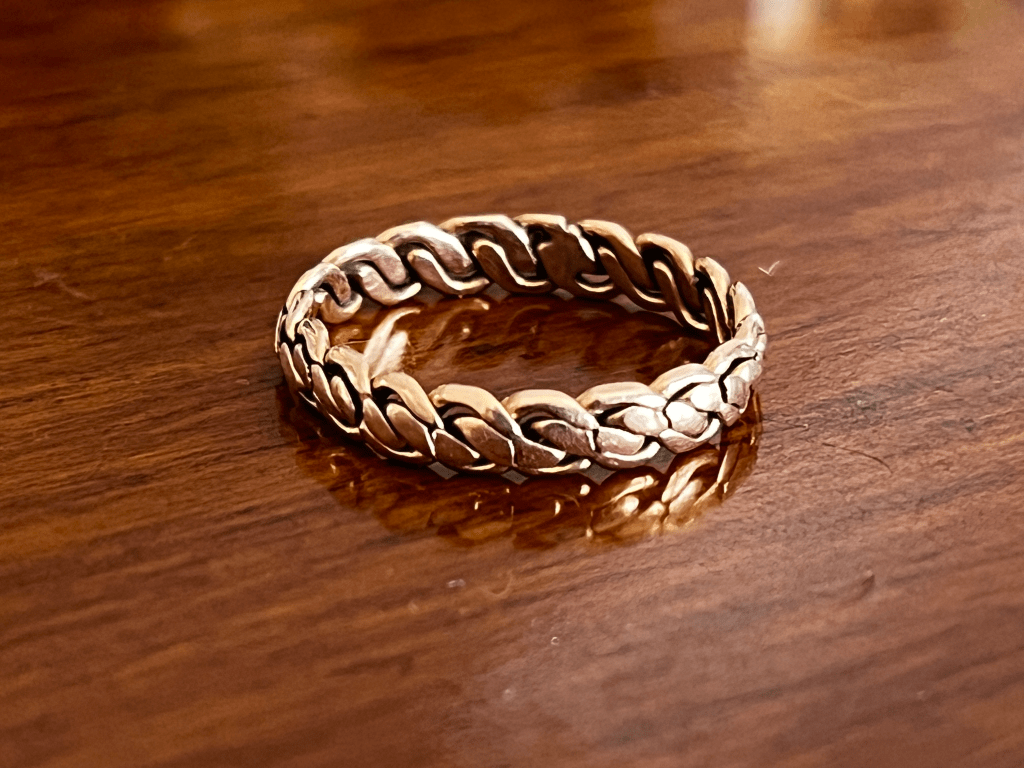
The ring, a peculiar braided design, was passed down to me from my grandmother Blanche (O’Shea) Mackey whose husband, Robert Mackey —my predeceased grandfather— had received it from one of his ancestors —likely from his own father.
The significance of this family heirloom, to me at least, is that it is at least 156 years old given that Catherine married my gg-grandfather, Robert Blenkinsop Mackey (1844-1917), on 18 April 1868 by the Reverend Edward Lee Sandiford at the stone-clad church of Kilmore parish on Valentia, Co. Kerry, Ireland. As with most wedding bands, she likely wore that ring every day of her life, through thick and thin, through good times and bad, through sickness and in health. Given that she was so young when she passed, the ring —given during such a joyous time in her life— may well have been witness to some significant suffering in the end.
Inspecting the Evidence!
You’ll notice that I said the ring was ‘at least’ 156 years old. That’s primarily because we are unsure of the ring’s provenance. You see, the ring may have been a family heirloom passed down from Catherine or Robert’s side of the family. As a family historian, I tend NOT to take things at face value without digging a little deeper into the topic. My research found that this type of braided wedding band was unusual for this time (Victorian era 1820-1914) and place (Ireland). Oh sure, the Irish knot type of ring was very common, but this is more of a braided or woven type of band. When I started scouring the internet for similar types of rings I found an article, ‘Antique wedding rings through the ages‘ on the Web site Lillicoco Antique Jewelry.
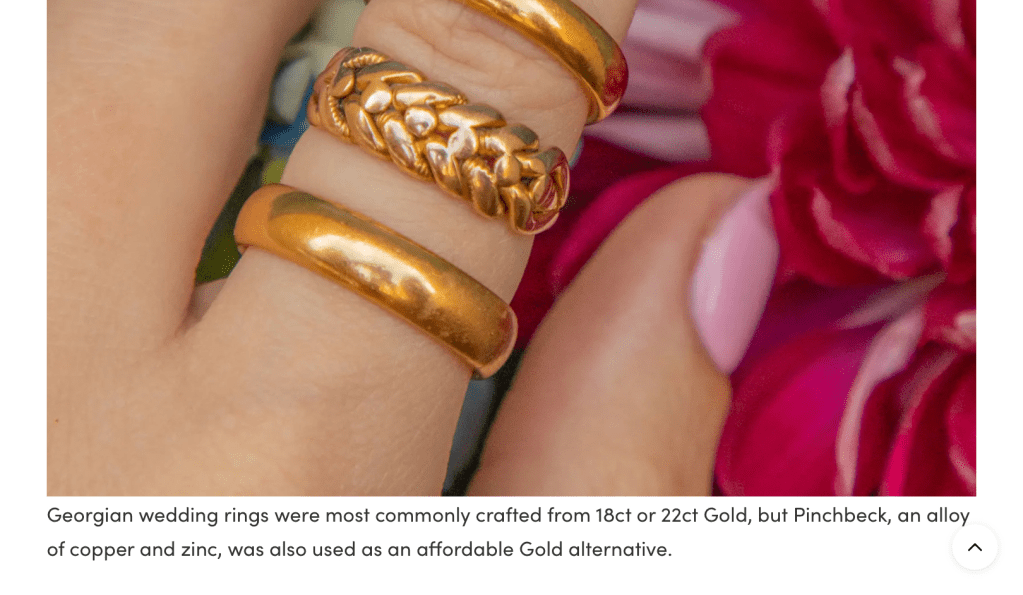
In the story, there was a similar wedding band but only during the Georgian era (1714-1830). Given that Catherine’s father Michael died in 1874 at the age of 84 —putting his birth year at 1790— and his ‘potential’ wife Hannah passing in 1867 —just months before Catherine’s wedding— it’s entirely possible that this beautiful heirloom was passed down from my gg-grandmother’s family. We may never know but it’s nice to think of the possibilities.
A Famine Baby!
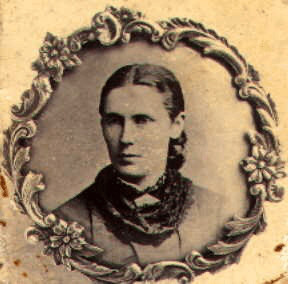
Catherine was born around 1848 —in the depths of Ireland’s ‘Great Famine‘— on the island of Valentia in County Kerry, Ireland. We have been unable to find an official birth or baptism record for her but through her death records and other sources we know she was born in this timeframe. Although we know very little about her younger life, we do know she must have lived through challenging times. The Irish Potato Famine started in 1845 and ran through 1852. Poverty, starvation and mass exodus from the Emerald Isle was a daily scene. While the Knight of Kerry —the resident Anglo-Irish hereditary landowner of most of Valentia island’s property— did take better care of the island’s residents than other parts of South Ireland owned by Trinity College, Catherine would not have escaped the destitution of those times. (Note: If you’d like to learn more about the different impacts of the Famine on lives of residents of Valentia vs nearby Caherciveen, Ireland —the hometowns of two of my g-grandfathers— check out this well researched paper by E. M. Rowan at University of PEI here or a Prezi of it here.) Little could anyone imagine that just over a decade after the Famine, Valentia would become an important hub for global communications and see an influx of young British Telegraphers —like Robert Mackey— come to the island. It would forever change the Island and its place in the world —now being considered for a UNESCO World Heritage Site status.
Running down the Emerald Aisle!
We don’t know how Catherine met my gg-grandfather but one can only imagine that she was enamoured with a handsome young man with a great profession and bright future. Was she a young maid working for the cable staff? Did they meet at the local sporting or social events? While none of these details have been passed down through time, some things can certainly be surmised from her marriage record. We know that most men in the telegraph world —a prestigious technology job similar to our internet startups of today— usually married women in similar societal levels to theirs. So, was this the case with Catherine? Well, there are some things about her marriage certificate that make one go hmmmm!
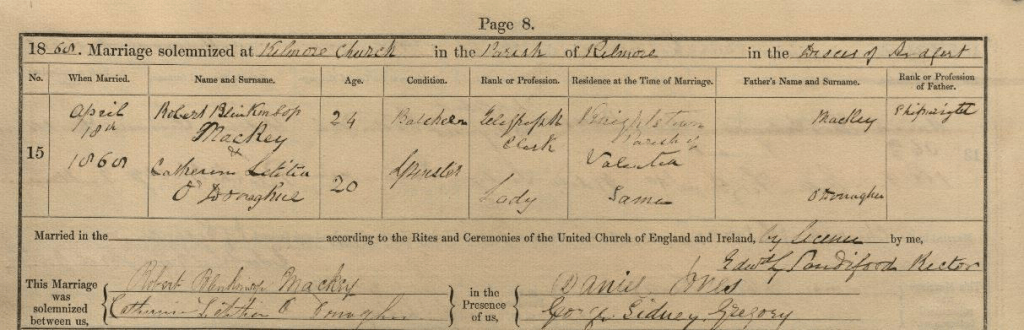
There is much that can be gleaned from Catherine and Robert’s marriage certificate when you look beyond the names and dates —as good family historians usually do. There are many unusual things happening in that certificate. First, and the most obvious piece, not having either fathers’ names listed was highly unusual for that time period as was not having Catherine’s father’s profession. Surely they knew both things but they were not included on the certificate.
Second, Catherine’s profession being listed as Lady —some have suggested that may imply she was living on her own means— is also highly unusual for that time period in Ireland unless her father was an upper class gentleman. It would be more usual to see something related to her father’s profession like Farmer’s daughter, her own profession like servant, or a blank line. Of course, IF her father was a gentleman —as was common for other fathers of children married at this particular church— she surely would have put his name on the certificate. (Note: Her father’s death certificate had his profession as farmer.)
Third, the marriage was by License vs the more common Banns —where the names are read out to the public in church three times in the weeks leading up to the event. Was this uncommon during those times? Not entirely, but when combined with the other interesting tidbits, it might point to a hurried marriage.
Finally, Kilmore Parish —the parish in which they were married— was a United Church of Ireland Protestant church of that time period. O’Donoghue was an Irish name and almost 100% of the Irish population were Catholic. Robert was from South Shields, England and would have been a Protestant at that time. Usually, men married in the wife’s parish and converted to their religion. So why was Catherine being married in a Protestant church? It sure seems like they were in a hurry to get married without anyone interfering in the process. The Power of Love no matter the religion? One can only surmise —but for the record the first live birth in their family was 20 months later 😉.
A Crossroads and a Path Less Taken!
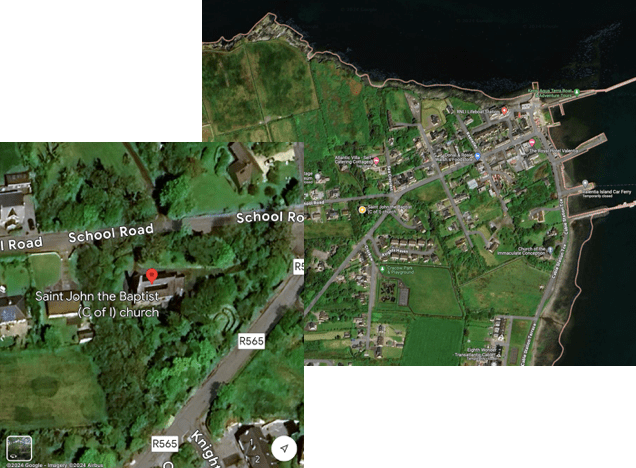
The church where Catherine and Robert were married in 1868 was only 8 years old at the time and is still standing today —although now just open during the summer months. It is a sturdy stone walled building with a beautiful wooden-beamed ceiling inside. Outside, it is surrounded by large trees and a lush ‘Sensory Garden’ for the handicapped —added in 2005 but which foreshadows a blog I am planning for later in the year. This is the same church in which other Telegraph staff and even the Knight of Kerry’s own children were married during that same timeframe.

The church’s location in town is at a crossroads of two paths in the quaint seaside town of Knightstown. I wonder how many people took the path less travelled after they exchanged vows and left the church with their new wedding bands and dreams of starting a new life together.
In Sickness & in Health!
No matter how it all started, my gg-grandparents had nine children together over a period of 16 years —four girls and five boys— the youngest being born when Catherine was 37 years old. I am sure there was a lot of love and joy in that household, given the prosperity they enjoyed from Robert’s work in the telegraph industry. Four of the five boys —George, Robert (my great-grandfather), Bernard and John— eventually had successful careers following their father into the same industry —as I have written about in recent blog posts. The four girls —Catherine, Letitia, Agnes and Theresa— all married well and moved away from Ireland —as was common for telegraph families of the time.
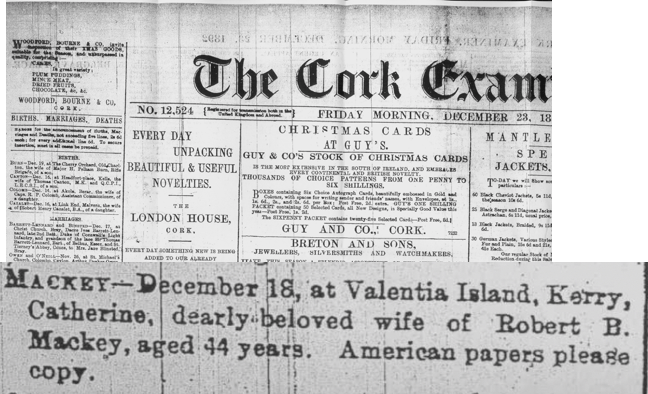
As I mentioned above, my heirloom was worn by my gg-grandmother through sickness and in health. She died in 1892 —at the very young age of 44— and from her death certificate we learn that she was sick for her last 3 years of life. This could not have been an easy time for her or the family. She suffered through illness while she had 9 children at home, ranging in age from 20 to 4. When she finally passed, on 18 December 1892, her eldest daughters were 23 and 20 while her youngest son Vincent —who was not blessed with life’s usual gifts— was just 7 years old. I am sure it wasn’t a great Christmas that year and the memories of their mother’s death likely persisted for many years to come —during what is usually a joyous time of the year. I could find no elaborate obituary for Catherine in the local newspapers just a small snippet in the Cork Examiner. It doesn’t seem to do justice for someone who brought 9 lives into the world. Perhaps she should have saved one life for herself!
Coming Full Circle
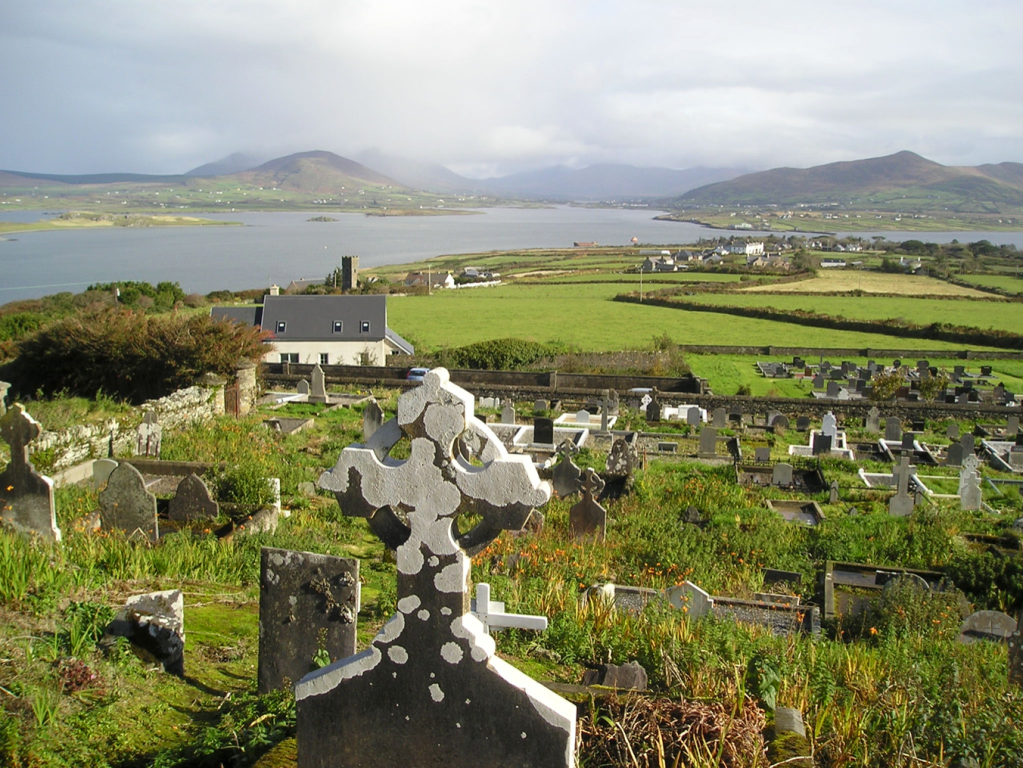
I have been to Valentia, Ireland several times starting in 1998 —in my early days as a genealogist— and most recently with my brothers and our parents in 2019. I have had opportunities to meet cousins who still live on the island to this day. During the most recent trip, we visited the Mackey plot in the local cemetery, where Catherine was laid to rest and where the remaining family eventually joined her. (Note: Robert’s 2nd marriage was in the Catholic Church and the family plot is located in the Catholic Cemetery.) It was my mother’s first time in Ireland —even though she had two grandfathers born there— and this part of the trip was extra special for her.
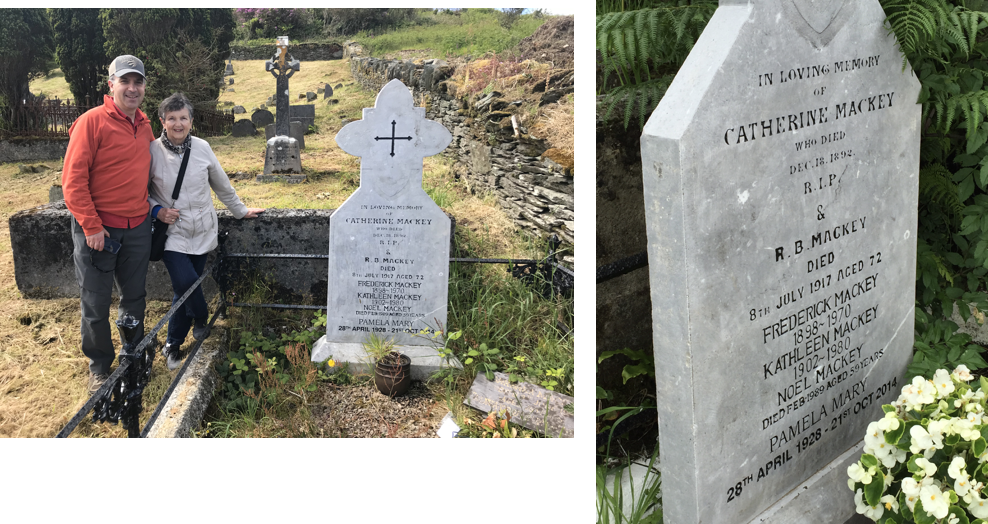
I am truly grateful to have such a treasured heirloom in my possession for safe-keeping. Hopefully, I will be able to eventually pass it on to the next generation, along with the story of Catherine’s brief life. I’d love to hear from you about your favourite family heirlooms. Leave me a comment or send me an email @ support@polynose.com

Photos and article © 2024 Bob Power unless otherwise attributed.
 Polynose Genealogy
Another interesting story! Marriage between Catholics and Protestants did happen, on occasion. I have a few instances in my family.
I have several items from a number of ancestors, but I haven’t picked which one means the most to me.
LikeLike
Thanks Bob. I appreciate the comments. It’s amazing the divide that religion causes to society especially back then.
Regards
Bob
LikeLike