DNA Origins?
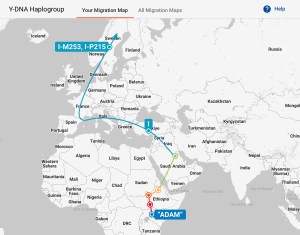
The prompt for Week 2 of the 52 Ancestors in 52 Weeks is ‘Origins’. To be honest, that threw me for a loop for a few days. I wasn’t really sure what to make of it. Could it be the origins of our surname? The place our family originally came from? (For me that would be a long list.) Or maybe this is a trick question to get us to talk about our DNA. Although I have spit in a vial more times than I should admit (having submitted DNA samples to 23andMe, Ancestry and more recently FamilyTreeDNA), I am not sure talking about my recently revealed Y-DNA haplogroup would make for exciting reading. Showing everyone the map of my family’s genetic journey out of Africa (see above) sure would make for a good geography and history lesson though. But, given the tough time I am having making my way through the book I received for Christmas; A Brief History of Everyone Who Ever Lived: The Human Story Retold Through Our Genes, I am not sure a brief blog on haplogroup I-M253 would keep the average person awake. And writing about the first caveman, Neanderthal, Homo Erectus, or Homo Sapien, to have the mental capacity and tools to light the first flame, although technically an ancestor, probably wouldn’t get everyone in the genealogy community all that excited either…sorry Blaine Bettinger.
Instead, since most people who will read these blogs are genealogists, or at least closet family tree enthusiasts, I decided to write about the ancestor who ‘lit the flame’ of my interest in genealogy. This person was the keeper and sharer of knowledge and is the “Origin” point for all the stories I have collected and and plan to share over the coming weeks. Of course, not every story will come from this ancestor. But without the spark they ignited, there would be no torch for me to pass onto the next generation. For me, there were two ancestors that immediately came to mind: my mother’s parents, Robert Mackey and Blanche (O’Shea) Mackey. My grandmother loved to write and my grandfather told with the most fascinating stories a young child would ever conceive. What a killer combo!
The Newfoundland Story Takes a Twist
Given my first blog, you might think my mother’s parents had great stories about my family in Newfoundland and how they persevered through the tough times in the fishing industry over many generations. That couldn’t be further from the truth. You see my mother’s family didn’t arrive in Newfoundland until 1952, after spending decades living in the Azores. As a pair, my mother’s parents had lived very interesting lives and their story could easily be the making of a great book. Stories of a grand estate home with servants, stories of pygmies, relatives in Egypt, relatives getting expelled from countries at gun point, relatives receiving jewel encrusted gifts from Russian czars, and others meeting with Spanish dictators. I am sure you get the point…”this was not my father’s Oldsmobile” as they say. As a child I grew up a short drive from my grandparents and saw them constantly. We even vacationed with them at times so there was ample opportunity for these amazing stories to be told and retold, over the years. My grandmother lived for almost 25 years longer than my grandfather so she and I even corresponded after I had graduated from university and moved away. I am lucky to have had that time with her. My grandmother was a prolific writer and recorded all the important facts and life events in various books and sheets of paper over the years. Thankfully, because of my interest in the family history much of this material was handed down to me when she passed away at the age of 97.
A School Project Changed the Game for Good
But what specifically lit the ‘flame’ you might ask? Well, it was a school project from my childhood that made me realize that something was different about my family story that didn’t align with the other kids I was growing up with. In elementary school, one of the projects we had to do was to complete a family tree and write a little bit about those ancestors back to grandparents or great-grandparents. Simple project right…nothing to see here. As I already mentioned, in a previous post, on my father’s side of the tree the Powers, and the other affiliated families, were on the island of Newfoundland from the 1700s. Given there wasn’t a ton of ethnic diversity or immigration into the province for decades, my father’s family was just like the rest of my classmates’. Irish and English ancestry to infinity and beyond! My Dad was born on Bell Island, his father Bell Island, his father Bell Island, and yup his father Bell Island as well…you get the picture.
I however, was not born on Bell Island. I was born in St. John’s, Newfoundland, the first generation born abroad you might say. This move was probably only due to the Bell Island iron ore mine closing down and the island losing the prosperity it had enjoyed for several generations. I grew up in a small farming town called Goulds, or better known locally as ‘The Goulds’, which was located on the Avalon Peninsula of Newfoundland right next to several small historic fishing ports like Petty Harbour and Bay Bulls. These towns were all located on the outskirts of St. John’s, the provincial capital and even more historic city founded in 1583 by Sir Humphrey Gilbert. So, when it came to the family trees of my classmates…most of them were very similar. The children were most likely born in Goulds, parents and grandparents might have even been born there as well, or in nearby Petty Harbour or Bay Bulls, a 10 to 15 km drive away by car. In fact, because the towns were so close and so small, many of the small group of names intermingled with each other, so much so that several of my classmates were cousins and I could never figure out ‘how’ as a child. Now to set the record straight, I am not highlighting this as a snub to my Newfoundland ancestors nor my classmates’ families, far from it. I mention it only to point out that most Newfoundland families usually didn’t move more than a stone’s throw away from where their fist ancestors arrived a century or more before. And like when I asked an Irish relative of mine, when visiting them in Ireland back in the 90’s, why they weren’t more interested in genealogy and the family tree, their reply was “ahh sure I can see them any time I want…me grandfather, great-grandfather, etc are all up in the grave yard up on the hill”. Same for me!!!
You Aren’t in ‘Newfoundland’ Anymore
My mother’s side of the tree, on the other hand, could not be further from this traditional model than if you asked Chat GPT to design an antithesis for this traditional Newfoundland tree. My mother was born in a sand storm on the island of Madeira, a Portuguese territory located 700km off the coast of Morocco and 850km SW of mainland Portugal. She grew up, until her early teens, in Horta on the island of Fayal which is part of the Azores islands, another Portuguese territory in the middle of the Atlantic Ocean between Ireland and Newfoundland, about 2187 km away from St. John’s.
My mother’s father, Robert Mackey, was born in 1906 on the island of Yap (the home of stone money) in the South Pacific ocean, a part of the archipelago of Caroline Islands, Federated States of Micronesia, which was closer to Guam, 843 km, than Newfoundland 12,785 km. As a young child, my grandfather moved to New York City with his family and grew up in Brooklyn before moving to the Azores in his 20s. As you might expect, his parents, my great-grandparents, were also foreigners to the Newfoundland story. His mother, Teresa Gatt, was born 1877 in Malta, a small island state 80 km south of Sicily, 284 km east of Tunisia, 333 km north of Libya and roughly 5,500 km away from Newfoundland. Robert’s father, an Irishman also named Robert Mackey, was born 1878 on the island of Valentia, off the coast of County Kerry, Ireland.
My grandmother, Blanche O’Shea, was born in New York City in 1913 and as a very young child moved to Canso, Nova Scotia, Canada with her parents as her mother was born and raised in the same town. Having spent most of her childhood in Canso, my grandmother eventually moved to the Azores with her parents after finishing grade 11. Blanche’s parents were also a nontraditional mix for that time period. Her father, John O’Shea, was born 1887 in the small town of Cahersiveen, County Kerry, Ireland, with deep Irish roots. This town was a stone’s throw away from the island of Valentia (home of Robert Mackey Sr.), Blanche’s future father-in-law . Her mother, Edith Cohoon, was born 1888 in the coastal town of Canso, Nova Scotia with deep Nova Scotia roots dating back to the 1760s.
After submitting this family tree project to the teacher, several of us were asked to stand up in class and talk about our trees. I remember the teacher saying “why don’t you tell us about your very interesting tree”. After hearing the other students present, it was at that very moment, that I realized that where I came from was very unique and special and I was determined to learn more.
And, that’s the ‘Origins’ story of my love of genealogy. It’s actually Origins2 because the bug came from 2 grandparents, and the interesting stories they passed on to me had an exponential impact on my view of the world and my interest in learning more about the family tree. On both sides of my tree I have such amazing stories to tell, some that weren’t even known to my parents and grandparents when they were alive. I hope to share a fraction of these stories with you over the next 52 Weeks.

Blanche O’Shea and Robert Mackey – Cafe Zanzibar in NYC – Sept 1945 post WWII
Photos and article © 2024 Bob Power unless otherwise attributed.
 Polynose Genealogy